
Automatic Gate Openers: Installation and Repair
An automatic gate is a set of parts that have to agree: the operator’s motor and gearbox, the control board, the sensors that watch the opening, and the gate itself, which has to move freely before the rest can work. We repair operators on swing and sliding gates, and we fit operators to gates that have only ever been opened by hand.
Signs Your Opener Needs Work
- The gate stops partway. The cause is often a limit switch out of adjustment, a bind in a hinge or track, or the operator’s force sensing stopping a gate that has grown harder to push.
- The motor hums but the gate does not move. The motor is trying and failing to turn: a worn capacitor, stripped gears or a jammed gate. If it runs freely while the gate sits still, check the manual release.
- The remote works only up close. Try a fresh battery first. If the range does not return, the receiver’s antenna may be damaged, disconnected or shut inside a metal box.
- The gate reverses for no reason. It is usually answering its safety devices: a photo-eye out of line or dirty, a safety edge with a cut strip or a broken wire, or a force setting the stiffening gate now exceeds.
- The opener runs slowly or noisily. Grinding, clicking or a labored stroke points to worn gears or bearings, a dry arm pivot, a tired motor, or a gate that drags.
Repairing a Stalled or Grinding Gate Operator
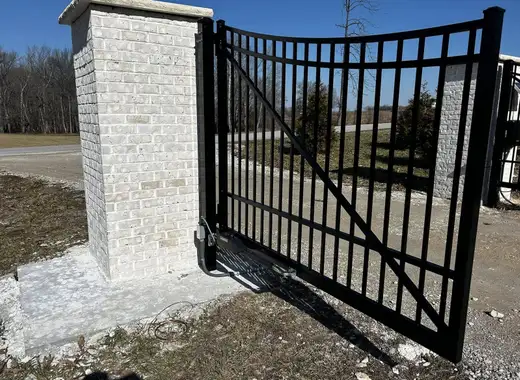
Most of our calls are for automatic gate operator repair, and Pittsburgh is hard on operators. Freeze and thaw cycles shift posts and stiffen pivots, road salt works at arms and brackets, snow packs into a slide gate’s track, and steep driveways load up swing arms and hinges. A gate that ran fine in October will often stall, grind or stop halfway by January. Andre Taylor, our owner, built the company around getting those gates moving again.
Tracing the fault comes before any part is replaced, because one symptom can have several causes: a gate that stops halfway may need its limit switches reset, or it may be dragging on a dropped hinge. Andre checks the hinges, posts and track before he touches the operator, the first step of Our Process.
Once the fault is found, the repair is usually one of these:
- Adjusting the limit switches, so the gate stops fully open and fully closed without straining against its stops.
- Replacing a worn motor that has lost its strength or runs hot.
- Replacing a control board that has failed, often after a power surge or water in the control box.
- Replacing photo-eyes and safety edges that no longer see the gate clearly or that report a fault.
When the operator is sound and the gate is at fault, a sagging post or hinge is straightened instead. When an operator, or the gate behind it, is not worth another repair, we say so.
Fitting an Operator to a Gate Opened by Hand
We add operators to existing gates. Many gates opened by hand for years can take one, provided the gate swings or slides freely by hand over its full travel, without dragging, binding or needing a lift to latch.
An operator adds force; it does not correct a fault. On a gate that sags it pushes against the bind on every cycle until its motor and gears wear out, so a sagging post or hinge is straightened first, as a gate repair. A swing gate also needs room at the post for the operator, a slide gate needs a level pad and a clear run, and both need power at the operator and a firm stop where the gate closes.
Wooden Gates and Double Gates
Can a wooden gate take an automatic opener?
Usually, if its frame is rigid and its posts are sound. Wood gains weight when it is wet and can twist as it dries, and an operator magnifies both problems. A wooden gate that has already racked or split may need its frame reinforced, or a new gate, before an operator is worth fitting.
Can a double driveway gate be automated as well as a single one?
Yes. A double swing gate usually takes an operator on each leaf, both run from one control board so the leaves open together and close in the right order. Each leaf has to move freely on its own first, and a drop rod that held a manual pair closed has to come off, or the operator will drive against it.
Gate Operator Types and the Gates They Drive
Operators are set apart by the gate they drive and where they sit. Which one suits a gate depends on how it opens, its length and weight, and the room around it.
| Opener type | Gate it drives | How it works | What to know |
|---|---|---|---|
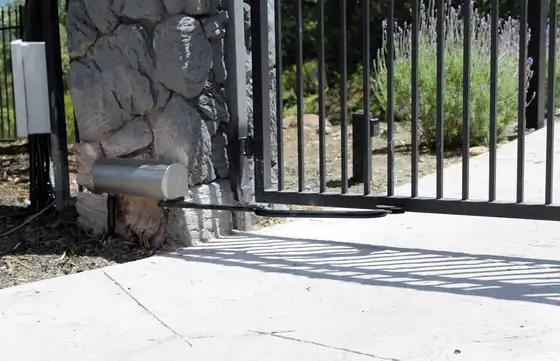
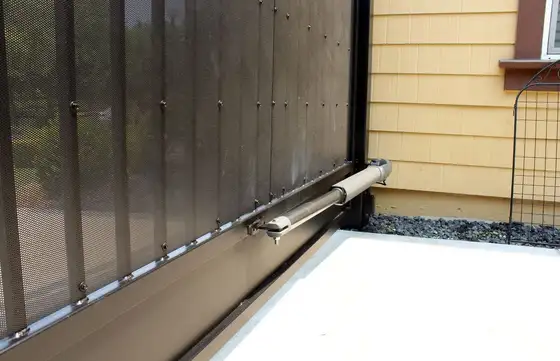
| Swing arm operator (articulated arm) | Swing gates, from the face of the post or pillar | A motor drives a jointed arm that folds and straightens like an elbow, pulling the leaf open and pushing it closed. | Suits wide pillars and hinges set back from the post face. The arm needs room to fold, and its pivots wear without grease. |
| Linear (ram) operator | Swing gates, between a bracket on the post and one on the leaf | A screw-driven ram extends and retracts in a straight line, swinging the leaf on its hinges. | Slim and neat, but it depends on accurate bracket positions. A sagging leaf pulls the ram out of line. |
| Underground swing operator | Swing gates, from a sealed box in the ground under the hinge | The motor turns the leaf at its bottom pivot, so nothing shows above ground. | Out of sight, but the box must drain. Standing water and debris in it are the usual cause of failure. |
| Slide gate operator (rack and pinion or chain drive) | Sliding gates, on a ground track or cantilevered on rollers | A motor on a pad beside the opening turns a pinion gear along a toothed rack on the gate, or pulls the gate by a chain. | Needs a level pad and a clear run. The rack has to remain meshed with its pinion, and a chain has to keep its tension. |
Safety Sensors and the Manual Release
Photo-eyes are a pair of small sensors on either side of the opening, one sending an invisible beam to the other. When a car, a person or a pet breaks the beam, the operator stops the gate or sends it back open. Safety edges are rubber strips on the gate’s moving edges that make the operator stop and reverse when they are pressed.
Both need to be clean, lined up and tested: a photo-eye nudged by a mower can keep a gate from closing, and a cut safety edge can leave it reversing for no visible reason. Worn sensors are among the parts we replace, testing them belongs in routine gate maintenance, and a gate should never run with a sensor bypassed.
Every operator also has a manual release, a key, lever or knob that disconnects the motor so the gate can be moved by hand. Your operator’s manual shows where the release is. In general, the steps run in this order:
- If the operator has its own power switch and you can reach it safely, turn it off.
- Open the release as the manual describes.
- Move the gate slowly by hand, keeping clear of the arm, the hinges and any rack or chain.
- When the power is back, close the release and switch the operator on again. Some operators then run one full cycle to find their limits.
Power Outages and Automatic Gates
What happens to an automatic gate when the power goes out?
That depends on the operator. Most stop where they are, open or closed, until the power returns or the gate is released by hand. Some carry a backup battery that keeps the gate working for a limited number of cycles, and some are set to open the gate when the power fails, so no one is shut in.
Why will the gate not move by hand even after the release is open?
Either the release has not fully disconnected the drive, or the gate itself is binding on a dropped hinge, a damaged roller or a blocked track. Do not force it or lever it with a bar, which can bend the frame or the operator’s arm; a gate that will not move by hand needs repairing before the operator can drive it again.