
Know Your Gate
A gate is a simple machine with a heavy job. Whatever it is made of and however it opens, it hangs on posts set in the ground, moves on hinges or wheels, and closes against a latch or a stop. A powered gate adds an operator to move it, a control board to run it and safety devices that stop it when something is in the way.
Knowing which part does what makes a fault easier to describe, and it explains why a problem in one part so often shows up in another.
The Parts of a Swing Gate
A swing gate turns on hinges like a door, but it is far heavier than a door and hangs from one side only, so nearly all of its weight bears on one post and two hinges. On a powered swing gate, an operator mounted at the hinge post pushes and pulls the leaf through an articulated arm.
Swipe sideways to see the whole drawing.
- Hinge post. Carries the whole weight of the leaf, and of the operator mounted on it.
- Hinges. Let the leaf turn and hold it at the right height. The top hinge takes most of the pull.
- Frame and rails. The outline of the leaf and the rails across it, which keep it square and stiff.
- Latch. Catches in a keeper on the latch post and holds the leaf shut.
- Latch post. Stops the leaf and takes the latch. It carries far less load than the hinge post.
- Operator and arm. A motor and gearbox on the hinge post that open and close the leaf through a jointed arm.
- Control box. Houses the control board that runs the operator and reads the safety devices.
- Photo-eyes. A sender and a receiver facing each other across the opening. A broken beam stops the gate from closing.
- Concrete footing. Holds each post plumb and firm in the ground.
The weak point of a swing gate is its hinge side. The leaf acts as a lever on the top hinge, pulling it away from the post while the bottom hinge pushes in, and over time that pull loosens fixings, wears hinge pins and tips the post toward the gate. A drop of a fraction of an inch at the hinges becomes a drag on the ground at the latch end.
The Parts of a Slide Gate
A slide gate moves sideways across the opening instead of swinging, so its weight rides on wheels along a track rather than hanging from a post.
Swipe sideways to see the whole drawing.
- Track. A steel rail set on or in the drive, which the wheels run along.
- Wheels. The grooved rollers under the bottom rail that carry the full weight of the gate.
- Guide rollers. A pair of rollers at the top of the guide post that hold the gate upright as it slides between them.
- Operator and chain drive. A motor and gearbox on a concrete pad that turn a sprocket, pulling a chain fixed to the gate to slide it open and shut.
- Safety edge. A pressure-sensitive rubber strip on the leading edge of the gate that stops or reverses it when it touches something.
- Limit stop. A gate stop fixed at the end of the track, which halts the gate at the limit of its travel.
Because the wheels carry the weight, a slide gate is only as good as its track. Anything that lifts a wheel, even a small stone, makes the gate climb, bind and strain the operator, and a bent section of track does the same on every cycle.
What Moves a Powered Gate and What Stops It
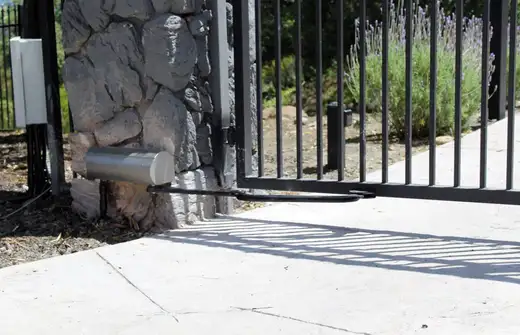
The operator is a motor and a gearbox that drive the gate, through an arm on a swing gate or a chain or toothed rack on a slide gate. The control board runs it: it takes the signal from a keypad, remote or intercom, starts the motor and watches the safety devices through the whole cycle.
Limit switches tell the board where the gate should stop at each end of its travel. Photo-eyes send a beam across the opening, and a safety edge reacts to touch; when either one senses something in the path of the gate, the board stops the gate or sends it back.
A manual release disconnects the operator so the gate can be moved by hand when the power is off or the operator has failed.
How Each Part Wears and Fails
Hinges and Posts
Hinges sag as their pins and barrels wear and their fixings loosen under the pull of the leaf. Posts move too: water that freezes and thaws around a footing can heave a post out of plumb, and a post set too shallow or in loose fill leans under the weight of the gate. Either way, the leaf drops, drags and stops meeting its latch.
Tracks, Wheels and Rollers
A slide gate’s track collects whatever lands on it, and packed snow and road salt are the worst of it: the snow lifts the wheels, and the salt eats into the track, the wheels and the bottom rail. Wheels and guide rollers wear in turn. A wheel with a flat spot or a dry bearing grinds, and a worn guide roller lets the gate lean and rub.
Sensors and Switches
A photo-eye knocked slightly out of line, or with a dirty lens, no longer sees its partner, and the board will not close the gate because it reads the lost beam as something in the way. A limit switch that has drifted out of adjustment lets the gate stop short, run hard into its stop or reverse at the end of its travel.
Motors and Control Boards
A motor that has worked against a dragging gate for months wears faster, runs hot and finally stalls. Control boards fail from age, from moisture in the enclosure and from power surges, and a failing board shows in erratic behavior: a gate that answers the remote one day and ignores it the next is one of the signs of a fault in the controls.
Which Gate Parts Wear First
Which parts of a gate wear out first?
On a swing gate, the hinges and the hinge post, because they carry the whole weight of the leaf. On a slide gate, the wheels and the track, because every cycle rolls the full weight of the gate across them. On a powered gate, the parts that wear fastest are usually the ones working against a fault somewhere else, such as a motor driving a leaf that drags.
Can one worn part damage the others?
Often it does. A sagging hinge makes the leaf drag, the drag makes the operator work harder, and the extra load wears its gears and motor and can trip its safety reversal. A dirty track does the same to the wheels and drive of a slide gate. Putting the first fault right early keeps the wear from spreading.