
Gate Maintenance and Servicing
A gate rarely stops without warning. It stiffens, squeals or drifts out of line first, and servicing is the routine work that catches those signs while they are small: hinges and pivots lubricated where they should be, fixings tightened, the track cleared, and the safety devices on a powered gate tested.
Manual and powered gates both need it. A manual gate has fewer parts, but its hinges, latch and posts carry the same loads, and a powered gate adds an operator, a control board and sensors that all depend on the gate moving easily.
Signs Your Gate Is Overdue for Servicing
- It has turned stiff. The gate takes more effort to open by hand, or the operator labors at the start of each cycle. Dry hinges, a dirty track or a roller that has begun to bind are the usual causes.
- It makes new noises. A squeal at the hinges, a grinding from the rollers or the operator, or a clunk at the end of travel points to wear that has already started.
- Rust or paint is failing. Bubbling paint and rust at the welds, the bottom rail and the hinge plates show where water sits on a steel gate, and those spots weaken first.
- It moves more slowly than it did. A powered gate that takes longer to open, or hesitates partway, is often working against friction the operator was never meant to fight.
- It sits slightly out of line. The latch needs a push to catch, the leaves of a double gate meet unevenly, or a slide gate rubs its guide rollers. Small misalignment grows when it is left alone.
Cleaning, Adjusting and Testing a Gate
Servicing works from the gate toward the operator, because an operator can only move a gate that moves freely. On a slide gate, that means the track, the wheels and the guide rollers first, then the chain or rack the operator drives. Parts made to be lubricated get the right lubricant; sealed bearings and the operator’s gearbox are left alone.

Fixings are checked for tightness, because a hinge bolt or an operator bracket that has worked loose lets the gate shift a little with every cycle until it binds. Chipped paint is noted while it is small, before rust gets under it.
Servicing the Operator, Photo-Eyes and Limits
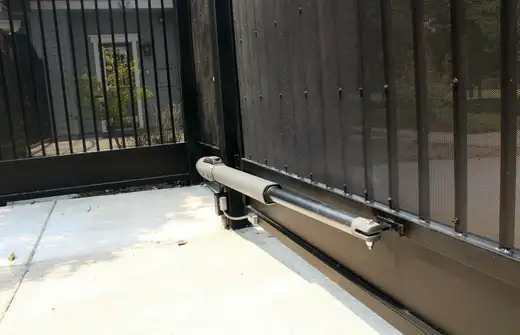
On a powered gate, servicing covers the operator’s mounting and arm as well as the gate. The arm’s pivot pins and brackets are checked for wear and play, since a loose bracket shifts the stroke and the limits with it. The manual release is worked to make sure the gate can still be moved by hand.
The safety devices get the closest attention. Photo-eyes are cleaned and lined up so their beam crosses the opening cleanly, and the gate is closed against an obstruction to confirm that it stops and reverses. Limit switches are checked so the gate stops in the same place at each end, and weak batteries in keypads and remotes are found before they fail.
Parts Checked When a Gate Is Serviced
| Part | What gets checked | What neglect leads to |
|---|---|---|
| Hinges | Wear at the pins, tight fixings and lubrication. | Squealing, a sagging leaf and hinge bolts pulling from the post. |
| Latch | Alignment with the keeper and a clean, positive catch. | A gate that swings open after it is shut, or has to be lifted to latch. |
| Posts | Plumb, firm in the ground and sound at the base. | A post heaved by frost or loosened at its base, dropping the gate out of line. |
| Track and rollers | A clean, straight track and wheels that turn smoothly without flat spots. | Grinding, a gate that jumps the track and an operator straining at every cycle. |
| Operator arm or chain | Pivot pins, brackets, chain tension and the operator’s mounting. | A chain that slaps or skips, a bent arm or a bracket torn loose. |
| Safety sensors (photo-eyes) | Clean lenses, alignment and a stop-and-reverse test. | A gate that will not close, or one that may not stop for a person or a car. |
| Limit switches | That the gate stops at the same point at both ends of its travel. | Overrunning into the stops, stopping short or reversing at the end. |
| Keypad and remote batteries | Battery condition and a clean response from each remote and keypad. | Remotes that work only up close, and a keypad that goes dark. |
Safe Checks an Owner Can Make on a Gate
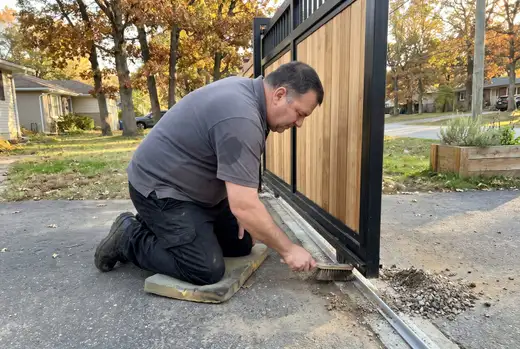
Between servicing, the person who uses the gate every day is the first to notice a change. None of these checks needs tools, access to the operator or any adjustment.
Make them with the gate standing still, and keep children and pets well clear whenever a powered gate is running.
- Watch a full cycle. Stand clear and watch the gate open and close. It should move at an even pace without shuddering, stop cleanly at each end and, on a double gate, meet evenly at the center.
- Listen for changes. A new squeal, grind or click, or a motor that hums without the gate moving, is worth reporting before it gets worse.
- Keep the track and the swing path clear. With the gate stopped, sweep leaves, gravel and litter out of a slide gate’s track and away from the arc of a swing gate.
- Keep snow and salt off the track. Shovel snow back from the track and the photo-eyes, and keep de-icing salt off the track, the wheels and the bottom rail, where it packs down and corrodes the metal.
- Keep the photo-eye lenses clean. Plants, cobwebs and dirt on a lens can stop a gate from closing. A soft, dry cloth is all a lens needs.
- Leave the operator and its settings alone. Never open the operator or the control box, and never adjust springs or limit settings. Those settings decide how hard and how far the gate moves, and a wrong one can defeat the safety reversal.
Servicing Frequency and Owner Upkeep
How often does a gate need servicing?
No single interval suits every gate. As general guidance, a gate is due for a look whenever it starts to sound, move or latch differently, and a gate that cycles many times a day at an apartment community or a business wears faster than a driveway gate at a home. Use is a better guide than a fixed calendar.
Does a manual gate need servicing too?
Yes, though less of it. A manual gate has no operator or sensors, but its hinges, latch and posts carry the same weight and wear the same way. Lubricated hinges, tight fixings and a latch that still meets its keeper keep a manual gate from sliding into a repair.
Should I lubricate the hinges and rollers myself?
The exposed hinge pins of a manual gate can take a light lubricant, and that is a reasonable job for an owner. Leave the operator, its chain or rack, and sealed wheels and rollers to servicing: some take a particular lubricant, some take none, and grease in the wrong place gathers grit that wears the part faster.