
Gate Installation and Replacement
We build and hang new swing and sliding gates in steel, aluminum and wood. A new gate may close an opening that never had one, or take the place of a gate that has reached the end of its life. Some properties need one driveway gate; others need a vehicle entrance and a walk-through gate beside it, planned together so the two match.
The choices that matter come early: which way the gate opens, what it is made of, how wide it is and whether it will ever carry an operator. Each one decides how heavy the posts and hinges have to be.
Signs You Need a New Gate
- Repairs keep coming back. The same sag, broken weld or latch fault returns soon after each repair, which usually means the gate is too light for its opening or its posts are not up to the load.
- The gate is beyond repair. Rust through the bottom rail or the hinge mounts, rot in a wood frame, or damage through the whole leaf leaves nothing sound to work from. While the posts and frame are sound, a repair is usually the better course.
- There is no gate where you want privacy or security. An open driveway, a side yard or the lane behind a business can be closed off with a gate sized to the opening and matched to the fence beside it.
- The driveway layout has changed. A widened drive, a new parking pad or a regraded slope can leave an old gate too narrow, or with no room left to swing.
Swing, Slide and Walk-Through Gates
Each type opens a different way and needs a different kind of space beside the opening. Slide gates come in two forms in the trade: the common type rolls on wheels along a track across the drive, while a cantilever gate hangs from rollers on posts beside the opening and never touches the drive.
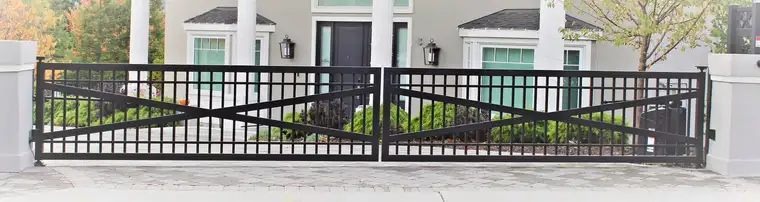
| Gate type | How it opens | Space it needs | Best suited to |
|---|---|---|---|
| Single swing gate | One leaf turns on hinges fixed to one post. | A level arc as wide as the leaf, on the side it opens toward. | Narrower drives with clear, level ground inside the gate. |
| Double swing gate | Two leaves turn on hinges at opposite posts and meet at the center. | Two shorter arcs, each about half the opening wide. | Wide driveways where one leaf would be long and heavy. |
| Slide gate on a track | Rolls sideways on wheels along a track across the drive. | A straight, level run beside the opening at least as long as the gate. | Drives that rise behind the gate, and openings with no room to swing. |
| Cantilever slide gate | Slides on rollers fixed to posts beside the opening, with nothing on the drive. | A run beside the opening roughly half again as long as the opening. | Uneven or unpaved ground, and openings where a track would fill with debris or snow. |
| Walk-through gate | A single narrow leaf on hinges, usually with its own latch or lock box. | A small arc clear of steps, plantings and the edge of the path. | Foot traffic beside a driveway gate, side yards and fenced yards. |
Slope matters as much as width. On a steep driveway, a swing gate either opens away from the rising ground or is hung so its bottom rail clears the slope through the whole arc, while a slide gate needs its run of level ground beside the opening.
Choosing Between Steel, Aluminum and Wood
Each material has its own weight, upkeep and look, and the material decides how heavy the posts and hinges have to be.
Steel
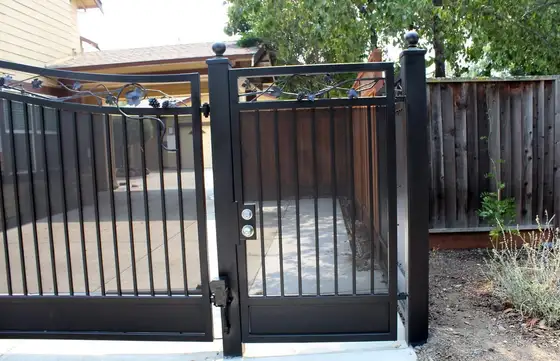
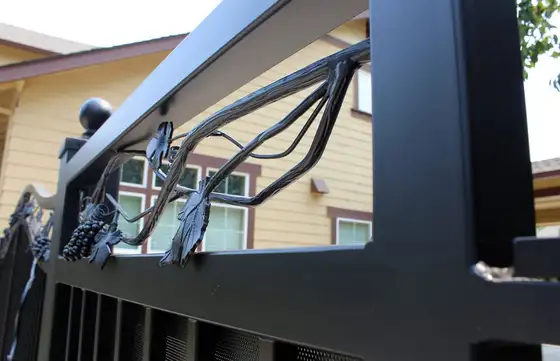
Steel is the strongest and heaviest of the three. It takes ornamental work such as spear-top pickets and forged vine rails, stands up to knocks and carries an operator well. Its weight calls for heavy hinges and deep-set posts, and its finish has to be kept sound, because rust starts wherever the paint or galvanizing has broken.
Aluminum
Aluminum is far lighter than steel and does not rust, which makes it easier on hinges, posts and operators and a sensible choice for long leaves. It dents and bends more readily when struck, so it suits a residential drive better than a busy commercial lot.
Wood
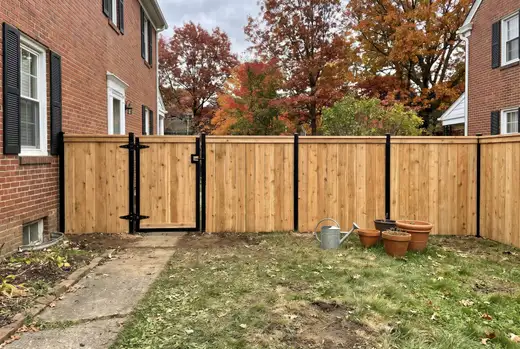
Wood gives the most privacy and matches a wood fence. It is also the material that moves most: boards swell and shrink with the weather, and a wood leaf that is not braced against its own weight sags toward the latch.
A steel frame behind the boards keeps a wood gate square, and a sealed or stained finish slows the weathering. A wood gate that will carry an operator needs that frame.
What to Decide Before a New Gate Is Built
- Material. Steel, aluminum or wood, chosen for strength, weight, upkeep and how it sits with the house and the fence.
- Width. Measure the opening between the posts, or where the posts will stand, and think about the widest vehicle that has to pass: a moving truck or a trailer needs more room than the family car.
- Manual or automatic. A gate that will carry an operator, now or later, needs a stiff frame, heavy hinges, posts sized for the load and power brought to the post. We add operators to existing gates, but a gate built with one in mind takes it more easily.
- Who uses it. A family driveway, tenants at an apartment community, a congregation arriving at a church and staff at a business each call for a different width, latch and way in. Keypads, remotes and intercoms are easiest to plan alongside the gate.
Choosing a Gate Style and Size
How wide should a driveway gate be?
Wide enough for the widest vehicle that will use it, with room on each side for mirrors and for a car that turns in at an angle. A drive that meets a narrow street needs more width than one with a straight approach. The clear opening between the posts is the measurement that matters.
Is one wide leaf or a pair of leaves better for a wide opening?
A pair splits the weight between two posts and needs half the swing room, which suits most wide driveways. It needs a drop rod or a center stop to hold the leaves in line, and an operator on each leaf if it is automated. A single leaf keeps the hardware simple but puts all of its weight on one post and one set of hinges.
Does a walk-through gate need to match the driveway gate?
It looks right when it does, with the same material, pickets and top rail. It should also hang from its own post, so the movement of the driveway gate is never felt at the walk gate’s latch. Its width suits people rather than cars: room for a stroller, a wheelbarrow or a wheeled trash can.