
Gate Signs and Symptoms
Most gate faults give warning before the gate stops: a squealing hinge, a scrape where the leaf meets the drive, a latch that needs a lift to catch, a motor that hums a moment too long. Caught early, those signs usually point to an adjustment or one worn part rather than a rebuilt gate.
Each likely cause is what the trade generally finds behind a symptom, and only a look at the gate confirms which one applies. Knowing the parts of a gate by name makes any symptom easier to describe.
Symptoms of a Failing Gate and Their Likely Causes
Urgency comes in three plain levels: Stop using it when the gate could fall, strike someone or move without warning, or when every attempt to run it adds damage; Book soon when the gate still works but the fault is loading other parts; and Plan ahead when the wear can wait for routine servicing or a planned replacement.
Swipe sideways to see every column.
| What you notice | Likely cause | How urgent it is | Service that fixes it |
|---|---|---|---|
| Gate sags or drags on the ground | Worn hinges, loose hinge bolts or a hinge post leaning out of plumb, so the latch end drops. | Book soon | Gate Repair |
| Gate will not latch | A dropped leaf or a shifted post, so the latch misses its keeper; less often, a worn latch. | Book soon | Gate Repair |
| Hinges squeal, creak or grind | Dry or rusted hinge pins and worn bushings, which also make an operator work harder. | Plan ahead | Gate Maintenance |
| Hinges pulling away from the post | Loose or stripped fasteners, a cracked weld, or a wood post too rotted to hold its screws. | Stop using it | Gate Repair |
| Frame bent or twisted | A vehicle strike, wind slamming the leaf, or an operator driving the gate into something in its path. | Book soon | Gate Repair |
| Rust holes or rot in the frame | Water trapped in steel tubing and at welds, or rot in wood rails; past a point, the frame cannot be saved. | Plan ahead | Gate Installation |
| Manual gate swings open or shut by itself | Hinges or hinge posts out of line, so the leaf swings toward its low side. | Book soon | Gate Repair |
| Powered gate sometimes stops partway | Limit switches out of adjustment, or a binding hinge or roller whose extra load the operator reads as an obstruction. | Book soon | Automatic Gate Openers |
| Motor hums but the gate does not move | A failed motor capacitor, stripped gears, a seized hinge or roller, or a manual release left half engaged. | Stop using it | Automatic Gate Openers |
| Gate reverses for no clear reason | Misaligned or dirty photo-eyes, a damaged safety edge, or a force setting that no longer suits the gate. | Book soon | Automatic Gate Openers |
| Gate does not stop for something in its path | Failed, misaligned or bypassed photo-eyes or safety edges, or a fault in the control board’s safety circuit. | Stop using it | Automatic Gate Openers |
| Opener runs slowly or noisily | Worn gears or bearings, a slack or dry drive chain, or a gate grown stiff on its hinges or rollers. | Plan ahead | Gate Maintenance |
| Slide gate grinds on its track in winter | Packed snow, ice or grit in the track, rollers worn flat, or a track bent out of line. | Book soon | Gate Maintenance |
| Gate will not close after a power cut | An operator left in manual release, a control board needing a reset, a dead backup battery, or surge damage. | Book soon | Automatic Gate Openers |
| Remote works only up close | A weak remote battery, a damaged or badly placed receiver antenna, or radio interference near the receiver. | Plan ahead | Access Control |
| Keypad buttons stick or do not respond | Worn buttons, water inside the housing, or corroded contacts and wiring. | Book soon | Access Control |
| Intercom is silent or crackly | Loose or corroded wire connections, water in the call station, a failing power supply, or a damaged cable run. | Book soon | Access Control |
Gate Symptom Checker
Choose what you notice, then press Show the Likely Cause.
Stop Using the Gate and Call Now
Some faults put people at risk, not just the gate. If any of these describes your gate, keep everyone clear, stop operating it and call (412) 226-4495.
- A leaf loose or leaning on a broken hinge. A steel driveway leaf can weigh several hundred pounds, all of it now on one hinge and the latch.
- A post moving at its base. Once the footing gives, the post and the leaf it carries can drop or swing without warning.
- A safety sensor that no longer stops the gate. A gate that keeps closing on something in its path protects no one.
- Exposed or damaged wiring. Bare or burned wires at the operator, the control box or a keypad post can carry line voltage, so keep hands and tools away.
- A gate that moves on its own. A powered gate moving with no command can strike a person or a car; switch it off at its power switch or breaker if that is safe to reach.
- A gate stuck partway across a driveway or walkway. It blocks the way and can start moving again without warning when the fault clears or someone presses a remote.
While a Gate Waits for Repair
How can I secure a gate that is stuck open or partway closed?
Switch a powered gate off at its power switch or breaker first, so it cannot move while anyone is near it. A leaf that is still sound on its hinges can then be chained and padlocked to its post, so wind cannot swing it.
A leaf that is leaning, hanging from one hinge or off its track should be left where it is, with a temporary barrier across the drive and people kept clear.
Can I move a powered gate by hand while it waits for repair?
Not while the operator is engaged. The motor and its gears hold the gate, and forcing the leaf can strip gears, bend an operator arm or twist the frame. Most operators have a manual release, usually a key, lever or knob, that disconnects the motor; use it only where and how the owner’s manual shows, with the power switched off first.
Leave the release alone if the leaf is leaning or hanging from a damaged hinge: the operator arm may be what is holding it up.
How do I keep people and pets away from a damaged gate?
Close off the opening on both sides with something easy to see, such as cones or a rope line, and keep children and pets indoors or on a leash. Tell everyone who uses the gate, deliveries included, that it is out of service. At an apartment community, a church or a business, a sign at the gate and a note to residents or staff do the same job.
Where Powered Gate Symptoms Usually Start
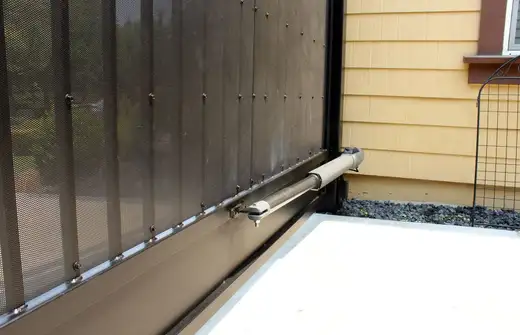
An automatic gate shows its faults through the operator, but the cause often sits in the gate. A linear operator pushes and pulls the leaf through a fixed stroke; when a hinge binds, a post leans or a roller drags, the extra load makes it stall, stop partway or reverse as if something were in the way.
Freeze and thaw make this worse: a post that shifts a little over a Pittsburgh winter takes the hinges, and the operator beside them, out of line.
Replacing the operator alone leaves that cause in place. Our Process starts with the gate for that reason.