
Our Process for Gate Jobs
For many people, a call to a gate company comes once every few years, usually when a gate has stopped working or a new one is needed. A typical job moves through the same stages: a phone call, a visit to look at the gate, an explanation and a choice, parts if the repair needs them, the work itself, and a final test with the remotes and codes handed over.
Some of this is particular to Beltzhoover Gate Services: the questions asked on the first call, the order in which a gate is inspected, and a plain answer about whether a repair makes sense. The rest follows the way gate work generally goes, and the details shift with the gate, the parts it needs and the property around it.
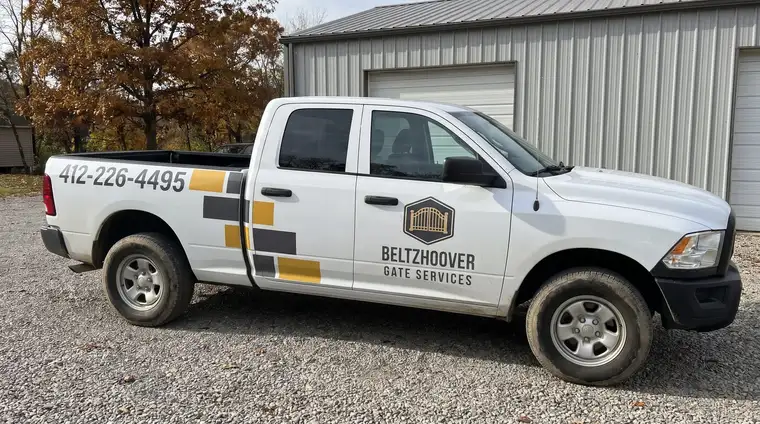
What the Phone Call Covers
When a call comes in, Andre Taylor asks what kind of gate it is, whether it swings or slides, and how it fails: dragging, sticking or not latching. He also asks whether the opener is manual or powered. Together, those answers usually narrow a gate problem to one part of the gate before the visit.
Each answer points somewhere. A swing gate hangs its weight on hinges and posts, while a slide gate rides on rollers along a track, so the same complaint means a different part on each. Dragging usually starts at the hinge side or at a post that has moved, sticking at a binding hinge, roller or track, and a latch that will not catch at a leaf that has dropped. A powered opener adds the operator, its control board and its safety sensors to the list.
Hinges, Posts and Track Before the Operator
On site, he checks the hinges, posts and track before touching the operator. An operator only moves the gate it is attached to, and a gate that binds on a worn hinge, leans on a shifted post or rides a fouled track makes any motor strain, stall or reverse. Replacing an operator without looking at the gate first tends to bring the same fault back.
He then explains what he found and what the repair involves. Some of the parts have trade names, such as a limit switch or a photo-eye, and they are easier to follow once you know what each one does on your gate.
Part of that explanation is whether the gate is worth repairing at all. We will tell you plainly when a repair makes sense and when a gate is worn past saving, and the decision about what happens next is yours.
Stages of a Typical Gate Job
Every job differs in its details, but most follow the same order, and each stage has something you can do to help it along.
| Stage | What generally happens | What you can do to prepare |
|---|---|---|
| The call | The questions cover the kind of gate, whether it swings or slides, how it fails and whether the opener is manual or powered. | Look at the gate before calling, note when the trouble began, and find the brand or model on the opener’s label if it has one. |
| The visit and inspection | The hinges, posts and track are checked before the operator is touched, since a gate that binds makes any opener struggle. | Clear cars, bins and stored items from the gate’s swing or track, keep pets inside, and know where the operator’s power switch or breaker is. |
| The explanation and the choice | You hear what was found and what the repair involves, and whether the gate is worth repairing at all. | If a landlord, a board or a property manager signs off on the work, have a way to reach them. |
| Parts, if needed | When a motor, a control board or a part made to fit is needed, it is usually ordered, and the repair is finished on a second visit once it arrives. | Ask how the gate can be used or secured until the part is fitted. |
| The repair or installation | The work itself: hinges reset, posts straightened, a frame repaired, operator parts replaced, or a new gate built and hung. | Keep people, pets and cars clear of the work area, and plan another way in and out while the gate is out of use. |
| Testing and hand-over | A finished gate is generally run through full cycles to see that it opens, closes, latches and stops for an obstruction, and any remotes and keypad codes are set and handed over. | Gather every remote in use and decide who should have the keypad codes. |
Before and Between Visits
Does someone need to be home for the visit?
It usually helps to have someone there at the start, to point out what the gate does, and at the end, to see it working and take the remotes and codes. Whether part of a visit can go ahead with no one present depends on the job and on access to the gate and its power, and that is worth settling on the call.
What happens if a part has to be ordered?
Some repairs need a part that has to come from a supplier, such as a motor, a control board or a piece made to fit the gate. In that case a second visit once the part arrives is how such repairs usually go.
In the meantime, ask whether the gate can be used as it is or should be secured open, closed or in manual mode until the part is fitted.
How do I describe the problem when I call?
Start with the four things asked on every call: what kind of gate it is, whether it swings or slides, how it fails, and whether the opener is manual or powered. For how it fails, plain words are clearest: it drags, it sticks, it will not latch, it hums but does not move.
If you would rather put it in writing, the same details fit in a request through Schedule a Visit.
Visit Preparation Checklist
Check off the items that are done, then press Check My List.